
Gain insight into the appropriate patient types for XIPERE® from experts in the field
Dive into these comprehensive case studies where retina and uveitis specialists share their perspectives on the clinical data and their clinical experiences with XIPERE®. These discussions illuminate potential treatment outcomes with XIPERE® and provide valuable insights to identify the appropriate XIPERE® patient types within your own practice.
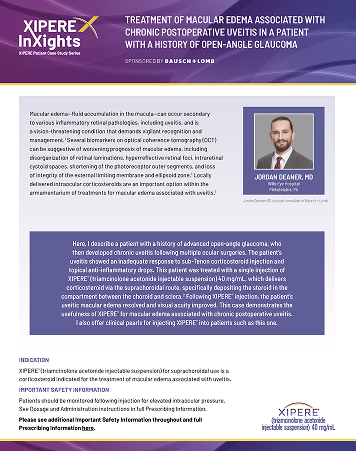
Treatment of Postoperative Cystoid Macular Edema Associated with Posterior Uveitis test
XIPERE® (triamcinolone acetonide injectable suspension) for suprachoroidal use is a corticosteroid indicated for the treatment of macular edema associated with uveitis.
Important Safety Information
Patients should be monitored following injection for elevated intraocular pressure. See Dosage and Administration instructions in full Prescribing Information.
XIPERE® is contraindicated in patients with active or suspected ocular or periocular infections including most viral diseases of the cornea and conjunctiva, including active epithelial herpes simplex keratitis (dendritic keratitis), vaccinia, varicella, mycobacterial infections, and fungal diseases.
XIPERE® is contraindicated in patients with known hypersensitivity to triamcinolone acetonide or any other components of this product.
Use of corticosteroids may produce cataracts, increased intraocular pressure, and glaucoma. Use of corticosteroids may enhance the establishment of secondary ocular infections due to bacteria, fungi, or viruses, and should be used cautiously in patients with a history of ocular herpes simplex.
Hypothalamic-pituitary-adrenal (HPA) axis suppression, Cushing’s syndrome, and hyperglycemia can occur following administration of a corticosteroid. Monitor patients for these conditions with chronic use.
In controlled studies, the most common ocular adverse reactions were increased ocular pressure, non-acute (14%), eye pain, non-acute (12%), cataract (7%), increased intraocular pressure, acute (6%), vitreous detachment (5%), injection site pain (4%), conjunctival hemorrhage (4%), visual acuity reduced (4%), dry eye (3%), eye pain, acute (3%), photophobia (3%), and vitreous floaters (3%), and in 2% of patients: uveitis, conjunctival hyperaemia, punctate keratitis, conjunctival oedema, meibomianitis, anterior capsule contraction, chalazion, eye irritation, eye pruritus, eyelid ptosis, photopsia, and vision blurred. The most common non-ocular adverse event was headache (5%).
Corticosteroids should be used during pregnancy or nursing only if the potential benefit justifies the potential risk to the fetus or nursing infant.
Please click here for full Prescribing Information.
Indication
XIPERE® (triamcinolone acetonide injectable suspension) for suprachoroidal use is a corticosteroid indicated for the treatment of macular edema associated with uveitis.
Important Safety Information
Patients should be monitored following injection for elevated intraocular pressure. See Dosage and Administration instructions in full Prescribing Information.
XIPERE® is contraindicated in patients with active or suspected ocular or periocular infections including most viral diseases of the cornea and conjunctiva, including active epithelial herpes simplex keratitis (dendritic keratitis), vaccinia, varicella, mycobacterial infections, and fungal diseases.
XIPERE® is contraindicated in patients with known hypersensitivity to triamcinolone acetonide or any other components of this product.
The information contained in this site is intended for US healthcare professionals only.
Click 'Confirm' if you are a US healthcare professional.
You are now leaving the XIPERE® website and are going to a website that Bausch + Lomb does not operate and to which Bausch + Lomb’s Privacy Policy does not apply. Bausch + Lomb is not responsible for the content, format, maintenance, or policies of the website you are about to visit and does not endorse or monitor any content on such website.